“Man of Steel, Man of Flesh, Man of Tomorrow, Person Today.”

Overview
This research-based project examines the iconography of Superman and his association to “Truth, Justice, and the American Way,” to investigate how we navigate the tension between our aspirations for heroism and salvation. Specifically. This body of work tackles how we, as a society, have negotiated power through our (mis)understanding of heroism and mythology. This is why I use the iconography of Superman, because of his strong identity within American culture, despite being an alien, and, technically, an illegal alien. Superman’s mythology reflects our national story, and influences how we define heroism and how they should wield power. But how does all of that hold up when we compare the characteristics of the people that actually possess power in American and how they wield it? This project began as a reaction to the 2016 election of Donald J. Trump as President of the United States, wondering about the cultural psychology and decision making, both historically and contemporaneously, that led to that outcome. Trump and Trump-ism represent something about America and how it thinks of itself in a similar way that Superman represents America, yet the two characters couldn’t appear more different. It’s notable that a considerable constituency view these two characters as of the same quality. Perhaps that’s true. What can we learn about America when we compare these two characters, who have each had a profound impact in the way we understand things like service, duty, patriotism, capitalism, sacrifice, legacy, and our American identity?
History/Background
description coming soon.
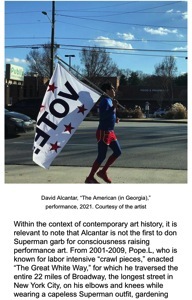
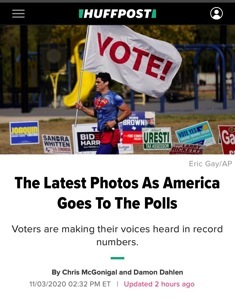
The American
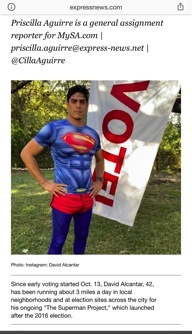
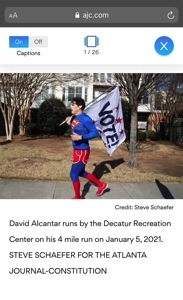
This performance art piece aims to directly impact civic engagement and participation by leveraging the iconography of Superman to encourage American citizens to exercise the power of their vote to shape the direction of their country. “The American” began as a public performance piece in October 2020, during the early voting period in San Antonio, TX., for the general election, and continued through election day. In this performance, the artist, dressed in a conglomeration of running apparel to look like Superman, runs a distance in the range of 2-5 miles along a city’s high visibility surface streets, carrying a 3’x5’ flag with a single word written in large letters: “vote.” After the general election, when it became clear that a run-off election in Georgia would be consequential to the history of America and decide which political party would have control of the U.S. Senate, the performance travelled to the state of Georgia under the title “The American (In Georgia)” to run in three counties in the days leading up to and through run-off election day. 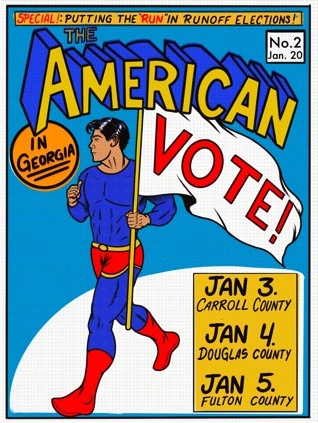
As state legislatures around the country propose and enact legislation targeting citizens’ ability to vote, stemming from a false belief by a large segment of their voters that the 2020 election was “stolen” from Trump by communities of color and immigrant communities, “The American” continues to be relevant, particularly since the story of Superman is the ultimate American story, because it is the ultimate immigrant story. But there is a tragic irony to the story: An illegal alien comes to small-town, U.S.A. as an infant, is raised with American mid-western morals by two loving parents, and being blessed with extraordinary power, because he is a literal alien, decides to be the champion for the country that raised him, and by extension, the planet. But because he was not born here, he cannot fully participate as a citizen, despite whatever powers he possesses and despite everything and anything he does for the place(s) he calls home.
Because of the elements of alienation, immigration, and diaspora that are inherent to the story of Superman, the next iteration of “The American” will take place along the U.S. Mexico border with a new flag, bearing Article 1 of the Universal Declaration of Human Rights written in Kyrptonian.
Press/Reports about “The American”
Kill Your Idols
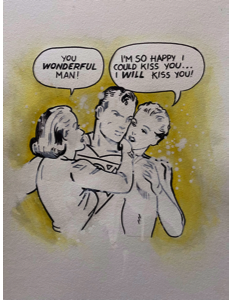
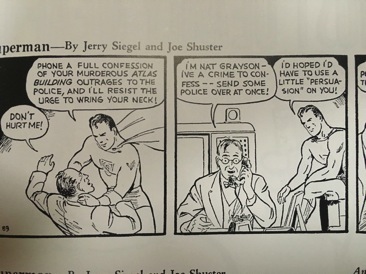
Artworks with the Title/subtitle “Kill your idols” directly address what could be considered hypocrisy unintentionally crafted into the mythology of Superman. When Superman was introduced for wide public consumption in 1938, he had been honed over many years while his creators were teenagers. Their ideas for superman were shaped by the context of their time period. Heroism then meant and was displayed very differently from how we understand it now. For example, it was not unreasonable for a “hero” of that era to resort to overt and even brutal extra judicial violence as a means to secure compliance or confession. Similarly, the treatment of women by the “hero’ was chauvinistic in a way as to think of them as objects of pity and subjugation. Over the years, the character of Superman has evolved away from past myopic behavior to incorporate modern understandings, but it is useful to look back and highlight where the character’s mythology “fails” in its heroism, so as to make him more relatable to us and the considerations we must make to more closely achieve the brand of Americanism he fundamentally represents.